

Actuators
Why Choose Us
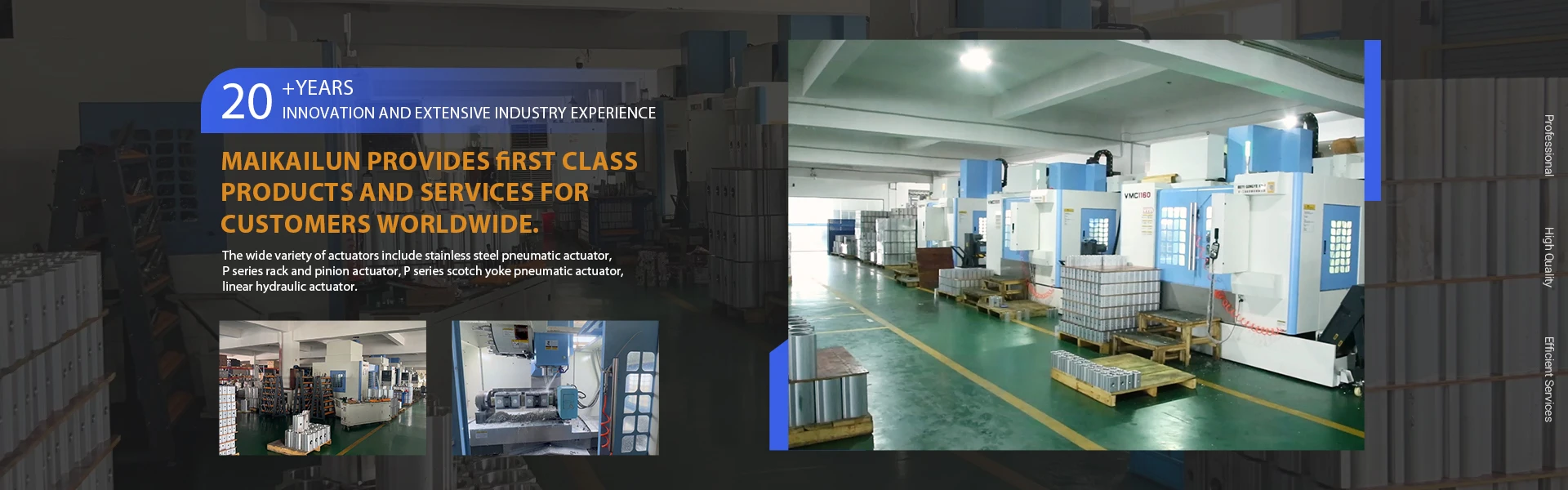
Zhejiang Maikailun Automatic Control Valve Co., Ltd is a well recognized world leader and reliable manufacturer for pneumatic actuator and pneumatic valve in China. With over 20 years innovation and extensive industry experience, Maikailun provides first class products and services for customers worldwide.
Wide Product Range
Maikailun supplies pneumatic actuators and valve control accessories such as manual override, limit switch box, solenoid valve, filter regulator, valve position feedback device etc.
Provide Solutions
Maikailun provides professional valve automation solutions like pneumatic ball valve, pneumatic butterfly valve etc. for diverse applications.
Quality Assurance
Our actuator ranges from Φ32~Φ400mm, torque covers from5Nm to 50000Nm.
Quick Response
Our commitment is to respond to your inquiries within 24 hours, ensuring that you receive the information and support you require in a timely manner.
-
![Single Acting Scotch Yoke Pneumatic Actuator]() Single Acting Scotch Yoke Pneumatic ActuatorThe single-acting scotch yoke pneumatic actuator is mainly used in the occasion of single-acting high-torque valves, providing a torque output of 500NM-70,000NM, which can realize the function of...read more
Single Acting Scotch Yoke Pneumatic ActuatorThe single-acting scotch yoke pneumatic actuator is mainly used in the occasion of single-acting high-torque valves, providing a torque output of 500NM-70,000NM, which can realize the function of...read more -
![Pneumatic Scotch Yoke Actuator]() Pneumatic Scotch Yoke ActuatorPneumatic scotch yoke actuator is a piston actuator, which is suitable for switching off or metering control of valves with a 90° angle (such as ball valves, butterfly valves, and plug valves).read more
Pneumatic Scotch Yoke ActuatorPneumatic scotch yoke actuator is a piston actuator, which is suitable for switching off or metering control of valves with a 90° angle (such as ball valves, butterfly valves, and plug valves).read more -
![Stainless Steel Pneumatic Actuator]() Stainless Steel Pneumatic ActuatorThe stainless steel pneumatic actuator block is made of stainless steel and is mainly used in corrosive environments. It integrates new technologies, innovates and optimizes the design through CAD...read more
Stainless Steel Pneumatic ActuatorThe stainless steel pneumatic actuator block is made of stainless steel and is mainly used in corrosive environments. It integrates new technologies, innovates and optimizes the design through CAD...read more -
![Double Acting Pneumatic Actuator]() Double Acting Pneumatic ActuatorDouble Acting Pneumatic Actuator is an actuator that converts the input air pressure signal to 90 degrees and outputs it in a torsionally rectangular form. This series of pneumatic actuators is a...read more
Double Acting Pneumatic ActuatorDouble Acting Pneumatic Actuator is an actuator that converts the input air pressure signal to 90 degrees and outputs it in a torsionally rectangular form. This series of pneumatic actuators is a...read more -
![Single Acting Pneumatic Actuator]() Single Acting Pneumatic ActuatorSingle-acting pneumatic actuators are a type of actuator commonly used in industrial automation systems. Its working principle is based on the principle of pneumatics, which enables power...read more
Single Acting Pneumatic ActuatorSingle-acting pneumatic actuators are a type of actuator commonly used in industrial automation systems. Its working principle is based on the principle of pneumatics, which enables power...read more -
![90 Degree Pneumatic Cylinder]() 90 Degree Pneumatic CylinderAre actuators that use air pressure to drive open, close or adjust valves, also known as pneumatic devices.read more
90 Degree Pneumatic CylinderAre actuators that use air pressure to drive open, close or adjust valves, also known as pneumatic devices.read more -
![135 Degree Pneumatic Cylinder]() 135 Degree Pneumatic Cylinder135 Degree Pneumatic Cylinder is mainly used in rotating and passive working conditions. Its advantage is that the response time is very fast, and the feedback of the signal can accurately control...read more
135 Degree Pneumatic Cylinder135 Degree Pneumatic Cylinder is mainly used in rotating and passive working conditions. Its advantage is that the response time is very fast, and the feedback of the signal can accurately control...read more -
![180 Degree Pneumatic Cylinder]() 180 Degree Pneumatic Cylinder180 Degree Pneumatic Cylinder is an actuator that uses air pressure to drive the opening and closing or regulating valve. It is also called a pneumatic actuator or pneumatic device, but it is...read more
180 Degree Pneumatic Cylinder180 Degree Pneumatic Cylinder is an actuator that uses air pressure to drive the opening and closing or regulating valve. It is also called a pneumatic actuator or pneumatic device, but it is...read more -
![3 Position Pneumatic Linear Actuator]() 3 Position Pneumatic Linear ActuatorPneumatic actuator has two kinds of models: 0°-45°-90° and 0°-90°-180°. The air intake "2" after the intake ends of the piston movement was designed to both ends there are auxiliary pistons...read more
3 Position Pneumatic Linear ActuatorPneumatic actuator has two kinds of models: 0°-45°-90° and 0°-90°-180°. The air intake "2" after the intake ends of the piston movement was designed to both ends there are auxiliary pistons...read more -
![Pneumatic Ball Valve Actuator]() Pneumatic Ball Valve ActuatorPneumatic ball valve is a ball valve with a pneumatic actuator, the execution speed of the pneumatic actuator is relatively fast, the fastest switching speed is 0.05 seconds / time, so it is...read more
Pneumatic Ball Valve ActuatorPneumatic ball valve is a ball valve with a pneumatic actuator, the execution speed of the pneumatic actuator is relatively fast, the fastest switching speed is 0.05 seconds / time, so it is...read more -
![Pneumatic Butterfly Valve Actuator]() Pneumatic Butterfly Valve ActuatorThe pneumatic butterfly valve is composed of a combination of pneumatic actuator and butterfly valve, because of the characteristics of the butterfly valve, such as light weight, simple structure,...read more
Pneumatic Butterfly Valve ActuatorThe pneumatic butterfly valve is composed of a combination of pneumatic actuator and butterfly valve, because of the characteristics of the butterfly valve, such as light weight, simple structure,...read more -
![Pneumatic Ptfe Lined Plug Valve]() Pneumatic Ptfe Lined Plug ValveA pneumatic PTFE lined plug valve is a type of valve that uses compressed air or gas pressure to regulate the opening and closing of a plug mechanism, which is coated with PTFE material.read more
Pneumatic Ptfe Lined Plug ValveA pneumatic PTFE lined plug valve is a type of valve that uses compressed air or gas pressure to regulate the opening and closing of a plug mechanism, which is coated with PTFE material.read more


Straightforward Design
Actuators system consists of a DC or AC motor, a series of gears, and a lead screw with a driving nut that pushes a rod shaft in and out.
Faster Assembly Time
Installing this only requires simple wiring. The simplified assembly process means faster integration into the entire ecosystem of the facility.
Smaller Footprint
An electric linear actuator is a self-contained unit mounted where the motion is required, which is then connected to the system controller with a small cable, it doesn't need much space to function efficiently. This gives people more flexibility when incorporating the actuator into the area.
Easy Integration
Electric linear actuator can also be integrated with other systems and equipment with no trouble at all. Programming the commands to the controllers that manage the facility's machines is less complicated than doing it with a hydraulic or pneumatic system.
Precision and Control
An electric linear actuator provides a higher level of control throughout the entire process. With just a few keystrokes on the controller, the operator fully controls the piston's position and applied force.
Safety
Most of these actuators come with limit switches. They're designed to send a signal to the drive to stop the motion when it reaches full extension and retraction. Limit switches help prevent the machine from stalling after it reaches its limit.
Eco-Friendliness
Electric linear actuators only use electricity as a source of energy, nothing else. It's clean and doesn't produce any by-products during use. Meanwhile, pneumatic actuators have compressed air that can blow contaminants into the environment.
Quiet Motor
Electric actuators use silent electrical motors, Produces almost no noise during operation.
Low Maintenance
This type of actuator has advanced to the point where it's virtually maintenance-free. Because it has fewer components, it has fewer points of failure. And its parts are easier to troubleshoot and repair or replace since most of them are just wires and gear systems.
Cost-Effectiveness
Since this kind of actuator doesn't have a lot of components, owners don't have to stock up on a lot of spare parts. It lets you cut back on labor costs, too, since it's easier to install, operate, and maintain.

Hydraulic Actuators
Hydraulic actuators typically work in a linear motion, and are commonly found in stepper motors as well as in applications that require clamping, opening, pressing and welding. They work by using hydraulic power to facilitate mechanical operation.
Pneumatic Actuators
Pneumatic Actuators work by using a pressurized gas or compressed air to create mechanical movement, which can be either linear or rotary. Pneumatic actuators are commonly found in industrial automation machinery, notably material handling applications that need to transfer, pick, place, clamp or index.
Electric Actuators
Electric actuators work on electricity, and they're often found in robotics equipment. Like pneumatic actuators, electric actuators can operate very precisely – often even more precisely than pneumatic actuators. They're also very scalable, reprogrammable, and speed and force can even be customized to a certain extent.
Rotary Actuator
The actuators that can provide a circular motion at their output can be classified under the category of rotary actuators. When it comes to rotational motion, it is hard to think of any other device than the motors, which we shall discuss in the next section of this article.
Linear Actuators
The actuators that can provide motion in a straight line at their output can be classified under the category of linear actuators. Hydraulic or Pneumatic actuators are the most common linear actuators used in the industry. We will also discuss these devices in detail.
Industrial Automation
Electric actuators allow these arms to move accurately and position themselves precisely on assembly lines in order to perform intricate operations. Cutting tools are also controlled with high precision by actuators in CNC machines. Rotating actuators facilitate complex movements needed for machining processes, while linear actuators position workpieces exactly.
Automotive Systems
With actuators, passengers and drivers can easily adjust their seats and windows to achieve maximum comfort. Actuators are also essential to optimizing engine performance, fuel economy, and emissions by controlling throttle positions, valve timing, and fuel injection systems.
Aerospace
Ailerons, rudders, and elevators, which control direction, stability, and maneuverability of aircraft, are controlled by actuators. A hydraulic actuator supports the aircraft weight during takeoff and landing by deploying and retracting landing gear. Spacecraft actuators are used to position antennas, deploy solar panels, control robotic arms, and deploy solar panels in harsh conditions.
Consumer Electronics
Actuators enable rapid and accurate access and storage of data on disk drives by precisely positioning read/write heads. During photography and video recording, actuators are used to improve image quality and reduce blur. Enhanced user interaction and a more immersive gaming experience can be achieved through tactile feedback systems in smartphones and tablets.
Medical Devices
The precision and efficiency of surgical robots are significant factors in minimally invasive surgery, which leads to better surgical outcomes. The use of actuators in prosthetics restores mobility and functionality for amputees with artificial limbs. For patient comfort and caregiver efficiency, hospitals, wheelchairs, and lift systems rely on actuators to adjust and assist patients.
Energy Sector
The pitch and yaw mechanisms in wind turbine blades are controlled by hydraulic and electric actuators, which maximize energy capture from wind currents and ensure safe operation. In oil and gas applications, actuators regulate the flow of resources and maintain operational integrity by controlling valves and control systems. Photovoltaic panels are moved throughout the day by actuators in solar trackers, maximizing the energy generated by the sun.
Home Automation
Actuators are used in smart home devices such as automated lighting, curtains, and climate control systems, allowing them to operate and adjust precisely in response to changes in user preferences. In residential settings, automation includes recliners, adjustable beds, and storage solutions that integrate actuators for smooth and customized movement.
Agricultural Machinery
Planting, harvesting, and soil management techniques are made possible with the help of actuators on tractor and harvester implements and attachments. Assuring optimal performance in challenging field conditions is possible with hydraulic actuators. The use of actuators in irrigation systems facilitates efficient water distribution and conservation practices for increased crop yields.
Electric Motor
The motor generates the rotational force that drives the actuator. This is typically through a gearbox assembly.
Gearbox
The gearbox lives between the motor and the lead screw. The gearbox is responsible for determining the speed and force of the actuator. Different gearing setups result in different force/speed combinations.
Lead Screw
The lead screw is where rotational motion is converted to linear motion. In a typical actuator, the lead screw spins with the output shaft of the gearbox. A captive block or nut is mounted on the lead screw and moves along the length of the screw as it spins.
Rod
Rod actuators have a rod assembly that is mounted to the nut and moves up and down the lead screw with the nut.
External Housing
Most actuators are encased by an external housing that keeps the components all in their proper place as well as protects them from the elements.

Frequently Asked Questions
As one of the most professional actuators manufacturers and suppliers in China, we're featured by quality products and low price. Please rest assured to buy high-grade actuators in stock here from our factory.
Pneumatic PTFE Lined Plug Valve, APL410 Limit Switch Box, Stainless Steel Solenoid Valve